
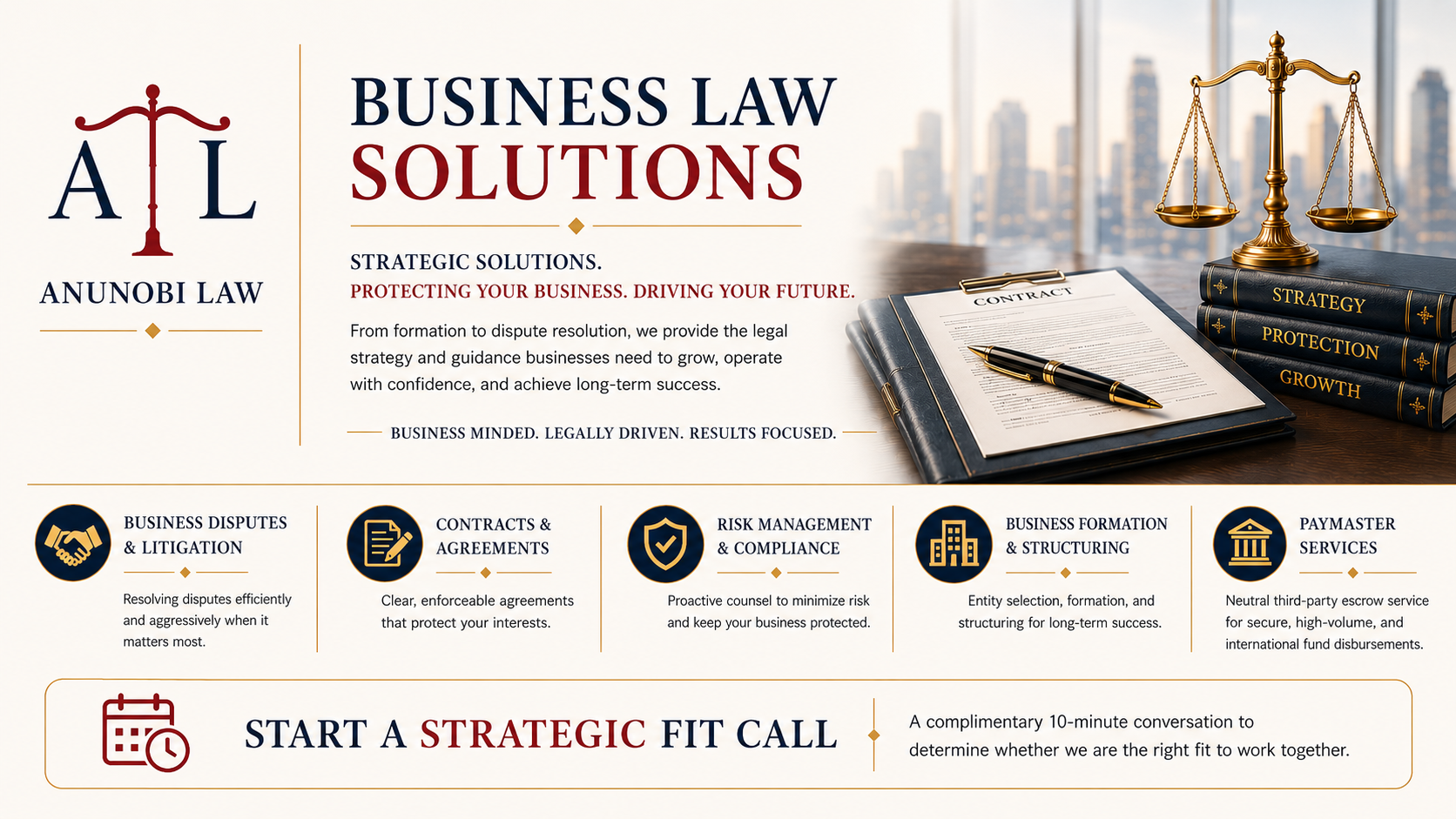

Houston Business Lawyers for Companies, Founders, and Owners
Running a business is a series of decisions with legal consequences — how to form, who to hire, what to sign, how to handle a dispute that’s about to become a lawsuit. Most of those decisions are made faster than they should be, by people whose attention is needed elsewhere. The role of a good business lawyer is to make sure the legal foundation under those decisions is solid, the contracts behind them are enforceable, and the disputes that do arise are handled with the right strategy, not just the right paperwork.
At Anunobi Law, we represent companies, founders, executives, and investors across Texas and internationally. Our business law practice combines transactional work — formation, contracts, risk management, advisory — with active litigation experience. We are equally comfortable drafting an operating agreement, structuring a cross-border transaction, holding escrow funds, or trying a breach-of-contract case to a jury.
This page is the gateway to our business law practice. Below, you’ll find an overview of every solution we offer, from the day a company is formed through the disputes that occasionally accompany its growth.
Contact us at: 832-538-0833
Table of Contents
Contact US
Business Litigation
When a business dispute can’t be resolved through correspondence or negotiation, the question becomes how to litigate it efficiently — protecting the client’s position without letting the dispute consume the business itself. We handle the full range of commercial disputes:
- Breach of Contract — Suits to enforce agreements and to defend clients accused of breaching them. Includes disputes over payment, performance, delivery, exclusivity, and termination.
- Breach of Fiduciary Duty — Claims involving partners, members, officers, directors, and majority shareholders who put their own interests ahead of the entity or its other owners. Texas treats these duties seriously, and remedies can include disgorgement, fee forfeiture, and punitive damages.
- Business Torts — Tortious interference with contract or prospective business relations, fraud and fraudulent inducement, conversion, conspiracy, and unfair competition.
- Contractor Disputes — Disputes between general contractors, subcontractors, and owners over scope, change orders, delays, defective work, and payment.
- Mechanics Liens — Filing, perfecting, and enforcing mechanics and materialmens liens under Chapter 53 of the Texas Property Code, and defending property owners against improperly filed liens.
- Non-Compete and Non-Solicitation Disputes — Enforcing reasonable restrictive covenants and defending against overbroad ones, with attention to Texas’s specific statutory framework under Section 15.50 of the Business & Commerce Code.
- Trade Secret Misappropriation — Claims under the federal Defend Trade Secrets Act (DTSA) and the Texas Uniform Trade Secrets Act (TUTSA), including injunctive relief, damages, and exemplary damages where applicable.
- Workers’ Compensation Disputes — Coverage, retaliation, and non-subscriber matters.
- Intellectual Property Disputes — Copyright, trademark, service mark, domain name, and logo disputes, including takedown demands, opposition proceedings, and infringement litigation where appropriate.
Litigation is expensive whether you win or lose, which is why we take strategy seriously from the first conversation. Many cases that look like they need to be litigated can be resolved earlier, on better terms, with the right pre-suit posture. Cases that genuinely need to be tried get tried.
Contract Drafting and Negotiation
A contract is supposed to do three things: capture the parties’ actual deal, allocate the risks they understand, and tell a court if it ever comes to that — what to do. Most disputes we litigate trace back to a contract that didn’t do at least one of those things. We draft, review, and negotiate the agreements that businesses run on:
- Non-Disclosure Agreements (NDAs) — One-way and mutual confidentiality agreements for use in transactions, employment, and partnership discussions.
- Trade Secret Agreements — Contractual protection for proprietary information, paired with the operational practices needed to maintain trade secret status.
- Employee and Independent Contractor Agreements — Including offer letters, employment agreements, IC agreements with proper classification analysis, and the restrictive covenants that go with them.
- General Contractor and Subcontractor Agreements — Construction industry agreements addressing scope, payment, indemnity, lien rights, and dispute resolution.
- Mutual Confidentiality Agreements — For situations where both parties exchange sensitive information.
- Ownership and Equity Agreements — Operating agreements, partnership agreements, shareholder agreements, buy-sell agreements, vesting schedules, and equity plans.
- Vendor and Supply Agreements — Master services agreements, statements of work, supply contracts, and license agreements.
- Asset and Equity Purchase Agreements — For company sales, acquisitions, and reorganizations, with attention to representations, warranties, indemnification, and post-closing covenants.
- Settlement Agreements — Drafting enforceable settlements that close litigation cleanly and don’t create new disputes.
The goal in every drafting engagement is the same: a document that the client can actually live with operationally and that holds up if challenged.
Business Formation and Governance
The decisions made at formation entity type, governance structure, ownership terms, tax election — determine how the business operates for years. Getting them right is far cheaper than fixing them later. We help founders and owners structure their businesses correctly from day one and clean up structures that weren’t.
Entity types we work with:
- Limited Liability Company (LLC) — The default choice for most closely-held businesses, offering liability protection with flexible governance and pass-through taxation.
- Limited Liability Partnership (LLP) — Common for professional services firms.
- Limited Partnership (LP) — Frequently used for investment vehicles, real estate holdings, and family wealth structures.
- General Partnership — Where appropriate, with attention to the personal liability exposure each partner accepts.
- C-Corporation — For businesses anticipating institutional investment, multiple classes of stock, or eventual public offering.
- S-Corporation — Where pass-through tax treatment is desired with corporate form.
- Series LLCs — For real estate and asset-segregation strategies under Texas law.
Governance documents we draft:
- Articles or certificates of formation
- Operating agreements and bylaws
- Shareholder, member, and partner agreements
- Buy-sell agreements with valuation mechanisms
- Equity incentive plans, vesting schedules, and profits-interest structures
- Voting agreements and proxy arrangements
- Resolutions, consents, and minute books
Business plan development. For founders raising capital or applying for loans, we work alongside accountants and consultants to make sure the business plan reflects the legal structure and complies with applicable securities and disclosure rules.
Risk Management and Compliance
Most legal problems in established businesses are self-inflicted: outdated policies, missing documentation, employee handbooks that don’t match actual practice, contracts signed without review. Our risk management work is preventive — identifying exposure before it becomes litigation.
- Corporate Books Management — Maintaining the records that establish the legal existence of the entity and protect the liability shield. Failure to maintain corporate formalities is a common ground for veil-piercing claims against owners.
- Employee Handbooks — Drafting and updating handbooks that comply with federal and Texas law and reflect the company’s actual practice. A handbook that contradicts what the company actually does is worse than no handbook at all.
- Policies and Procedures — Anti-harassment and anti-discrimination, leave policies (FMLA where applicable), workplace conduct, technology and BYOD policies, social media, and remote work.
- Regulatory Advisory — Industry-specific compliance issues, including healthcare, financial services, and professional licensing matters.
- Risk Assessment — Comprehensive legal-risk audits of an existing business, identifying contract gaps, employment exposure, IP vulnerability, and governance issues.
This work is most valuable when commissioned proactively — typically at inflection points like a financing round, a key hire, an acquisition, or a major new contract.
Strategic Advisory
Some of the most consequential business decisions don’t begin as legal questions, but they end as legal documents. Whether to enter a new market, expand a product line, take on a partner, or restructure a relationship — these decisions benefit from counsel that understands both the legal and the business dimensions. Our strategic advisory engagements include:
- Feasibility Studies — Evaluating proposed transactions, market entries, and partnerships from a combined legal and commercial perspective.
- Gap Analysis — Identifying what’s missing between where the business is and where it wants to be.
- Small Business Advisory — Ongoing counsel for closely-held businesses on the recurring questions that don’t justify a full-time GC.
- Strategic Plan Assessment — Reviewing existing strategic plans for legal viability, regulatory compatibility, and risk exposure.
- Strategic Plan Development — Building out execution plans with attention to entity structure, contract architecture, and risk allocation.
Many of these engagements can be structured on a flat-fee or retainer basis so the client knows what they’re spending before the work begins.
International Business
For companies operating across borders — whether U.S. companies expanding abroad or foreign companies entering the U.S. market — we provide the structuring, regulatory, and transactional support international transactions require. Our international practice includes:
- Market Entry Advisory — Structuring U.S. entry for foreign companies, including entity choice, licensing, immigration considerations for key personnel, and contract architecture.
- Host Country Advisory — For U.S. companies expanding into foreign markets, working with local counsel to coordinate entity formation, regulatory compliance, and operational risk management.
- Local Content Advisory — Compliance with local-content and indigenization requirements common in resource-extraction and infrastructure markets.
- Technical Partnership Advisory — Structuring joint ventures, technology transfer agreements, and licensing arrangements between U.S. and foreign parties.
- International Pay Master Services — Acting as escrow and disbursement agent on international transactions, including commission distributions, joint venture distributions, and multi-party closings. (See Escrow and Pay Master Services below.)
- EB-5 Investor Visa — Legal support for the EB-5 immigrant investor program, including investment structuring, source-of-funds documentation, and coordination with immigration counsel.
International transactions amplify every weakness in a contract or structure. Choice-of-law and forum-selection clauses, tax treaty considerations, currency risk allocation, and enforcement mechanisms all need to be thought through deliberately.
Escrow and Pay Master Services
Some transactions require a neutral third party to hold funds and disburse them according to the parties’ agreed instructions. Our firm provides escrow and pay master services for transactions where independence, regulatory familiarity, and contractual precision matter:
- Commission and finder’s fee distributions — Holding funds pending performance milestones and disbursing to multiple parties under negotiated waterfall provisions.
- Joint venture proceeds — Receiving and distributing transaction proceeds among JV partners.
- International closings — Holding funds across borders pending satisfaction of closing conditions in multiple jurisdictions.
- Settlement proceeds — Holding settlement funds and disbursing to claimants, lienholders, and counsel under structured payout terms.
- Real estate transactions — Earnest money and closing escrows where required.
Pay master engagements are governed by a written escrow agreement that specifies the conditions for disbursement, treatment of disputes, and the agent’s duties and limitations of liability. We require clear, executable instructions before accepting funds, which protects everyone involved.
Mediation and Alternative Dispute Resolution
Litigation is one path. Mediation, arbitration, and structured negotiation are others, and they are often better paths — faster, cheaper, more confidential, and more likely to preserve a commercial relationship that still has value. We offer:
- Representation in mediation — Preparing the case, the brief, and the client for a productive mediation.
- Mediation services — Serving as a mediator for other parties’ commercial and family business disputes.
- Arbitration — Representing clients in commercial arbitrations under AAA, JAMS, and industry-specific rules.
- Pre-suit demand and negotiation — Resolving disputes through structured demand letters and negotiation before litigation begins.
The right dispute-resolution tool depends on the case. Sometimes the leverage of filed litigation is what produces a settlement. Sometimes the formality of litigation is what destroys the deal. Choosing well is part of the strategy.
Why Anunobi Law
What we offer business clients:
- A combined transactional and litigation practice. Many firms do one or the other. We do both, which means our drafting is informed by what we actually see in court, and our litigation strategy is informed by how the underlying deal was structured.
- Board-certified leadership. Attorney Anunobi is board certified by the Texas Board of Legal Specialization — a credential held by a small minority of Texas attorneys.
- Recognition. Recognized by Thomson Reuters Super Lawyers.
- International capability. Our practice handles cross-border transactions and partnerships with the structuring rigor those engagements require.
- Sensible engagement structures. Many transactional and advisory engagements are available on flat-fee or retainer basis. Litigation engagements are scoped clearly with budget transparency.
Read more about our attorneys, including Chidi D. Anunobi and Okezie Chukwumerije, or our firm’s approach.
Areas We Serve
Anunobi Law represents business clients throughout Texas, with a primary practice in Harris County, Fort Bend County, Montgomery County, Brazoria County, and Galveston County.
Key cities we serve include: Houston, The Heights, River Oaks, Missouri City, Sugar Land, Stafford, Richmond, Pearland, Cypress, Conroe, The Woodlands, Spring, Tomball, Rosharon, Pasadena, Bay Town, League City, and Katy.
International clients are served from our Houston office and through our international correspondent network.
Contact Us
We offer free initial consultations for prospective business clients. Whether you need transactional support, ongoing advisory, or representation in a dispute, we’ll evaluate your situation and tell you honestly how we can help.
Phone: 832-538-0833
Email: contact@businessandfamilylawyers.com
Office: 1415 North Loop West, Ste. 1140, Houston, TX 77008
Related Resources
- Business Law Resources
- Frequently Asked Questions
- Business Minutes
- Business Deep Dive
- Articles & Blogs
Other Practice Areas