
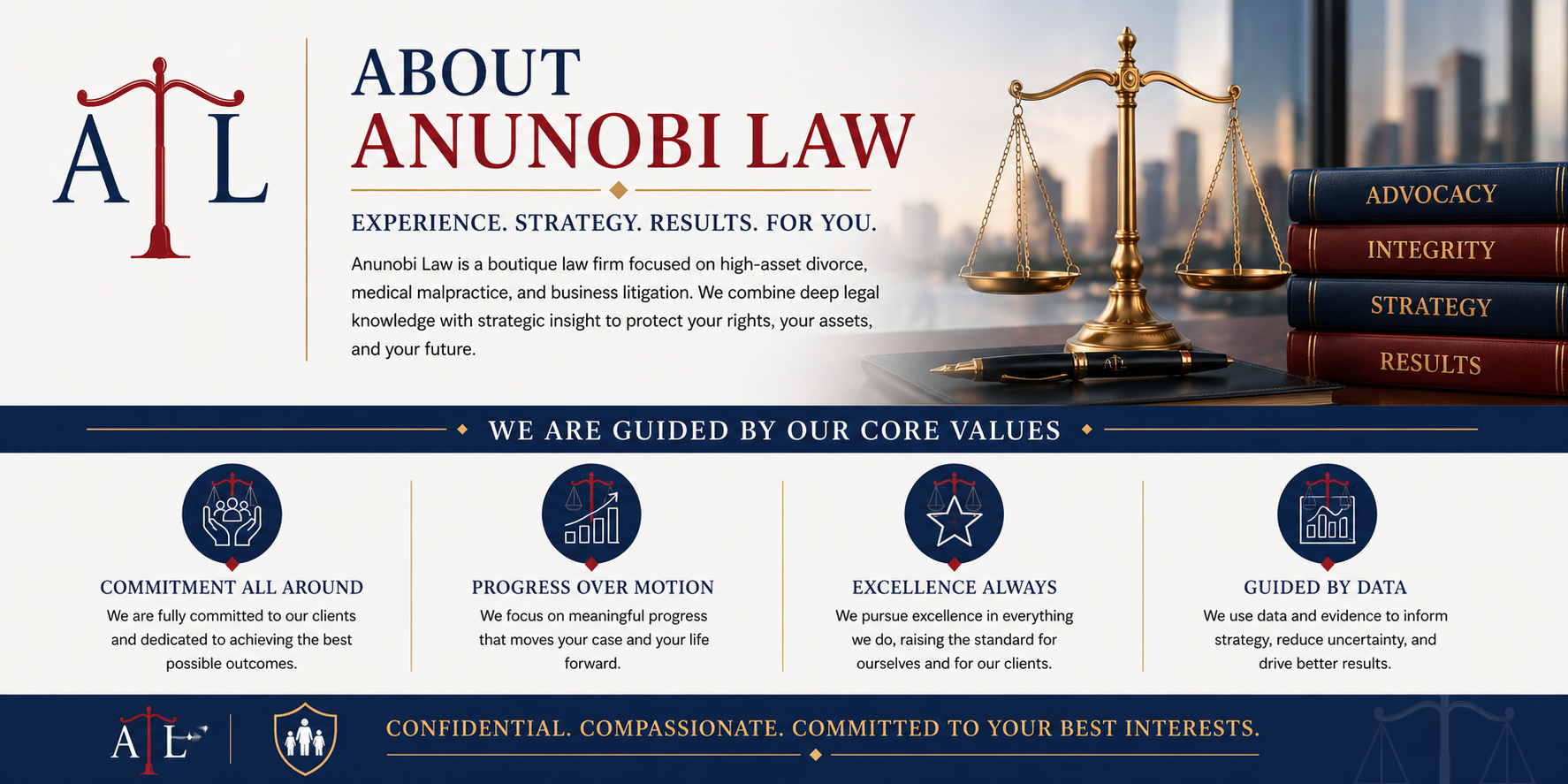

A Houston Law Firm Built Around the Client Experience
Anunobi Law PLLC is a Houston-based firm with reach that extends well beyond it. Our family law practice serves Texans throughout the state, our medical malpractice practice represents patients nationwide, and our business law practice serves clients internationally.
What we look like on paper is a boutique firm. What we feel like in practice is something more deliberate: a firm organized around a defined client experience, run by attorneys with credentials that include board certification by the Texas Board of Legal Specialization and recognition by Thomson Reuters Super Lawyers, and committed to making quality legal help accessible to people who need it.
The pages below walk through how we think about the work and what clients can expect from us.
The ALICE Equation – Our Operating Principle
Most law firms describe themselves with adjectives. We describe ourselves with an equation.
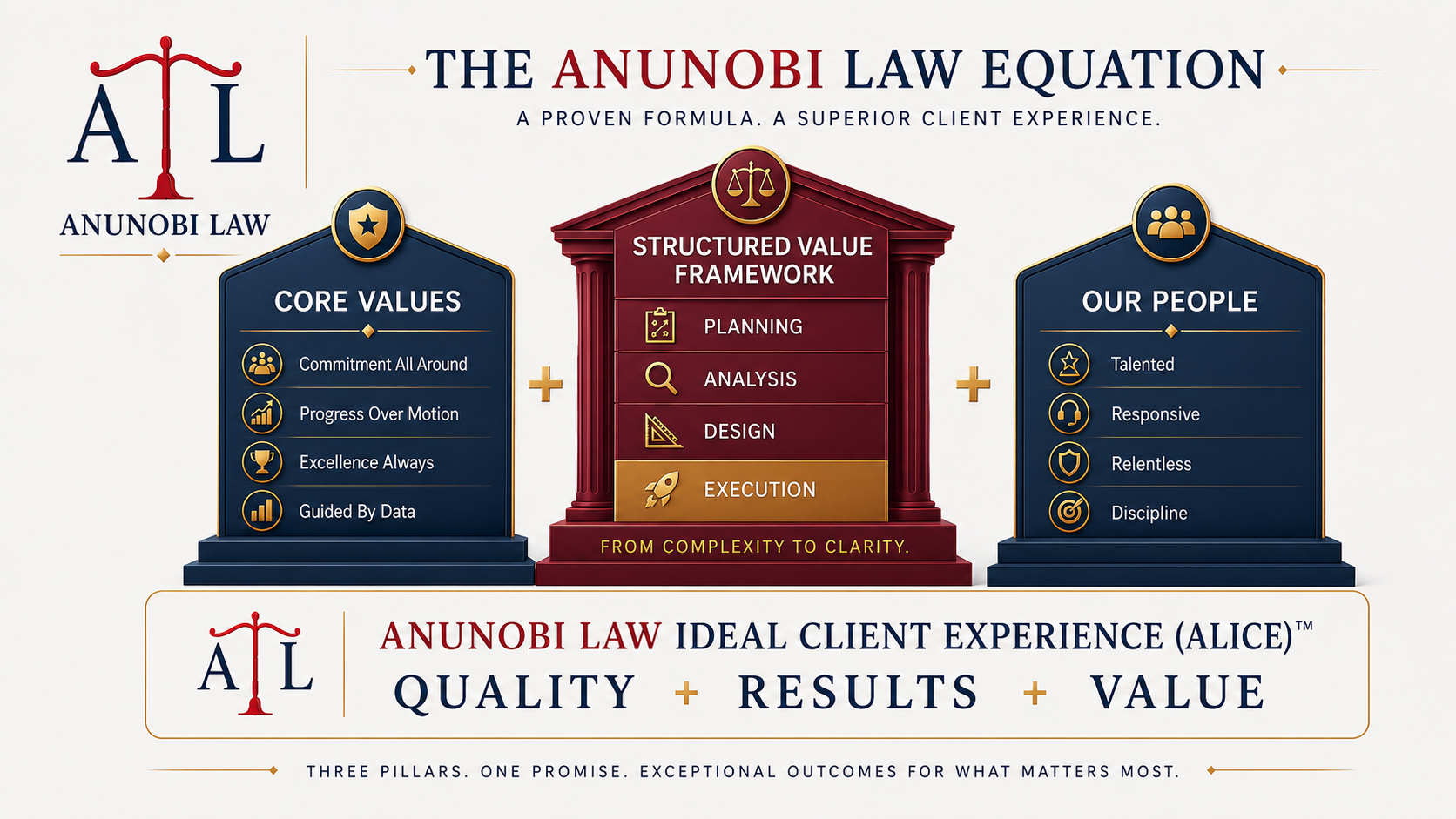
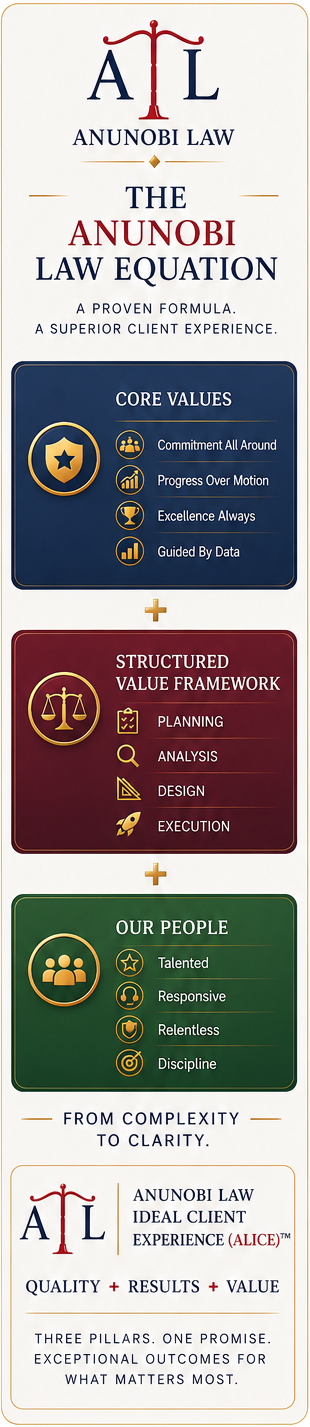
Our Core Values + Our Approach + Our Team = ALICE
ALICE stands for Anunobi Law’s Ideal Client Experience. It is the standard we hold ourselves to on every matter — quality representation that helps our clients achieve the results they seek, at a value that makes the engagement worthwhile.
Three things make ALICE more than a slogan:
1. Core Values: what we will and won’t do, regardless of the case.
2. Approach: how we structure our work so that quality isn’t accidental.
3. Team: the attorneys and staff who do the work.
When all three line up, the client gets Quality, Results, and Value. When any one of them falters, the equation breaks — and we lose the right to represent that client well.
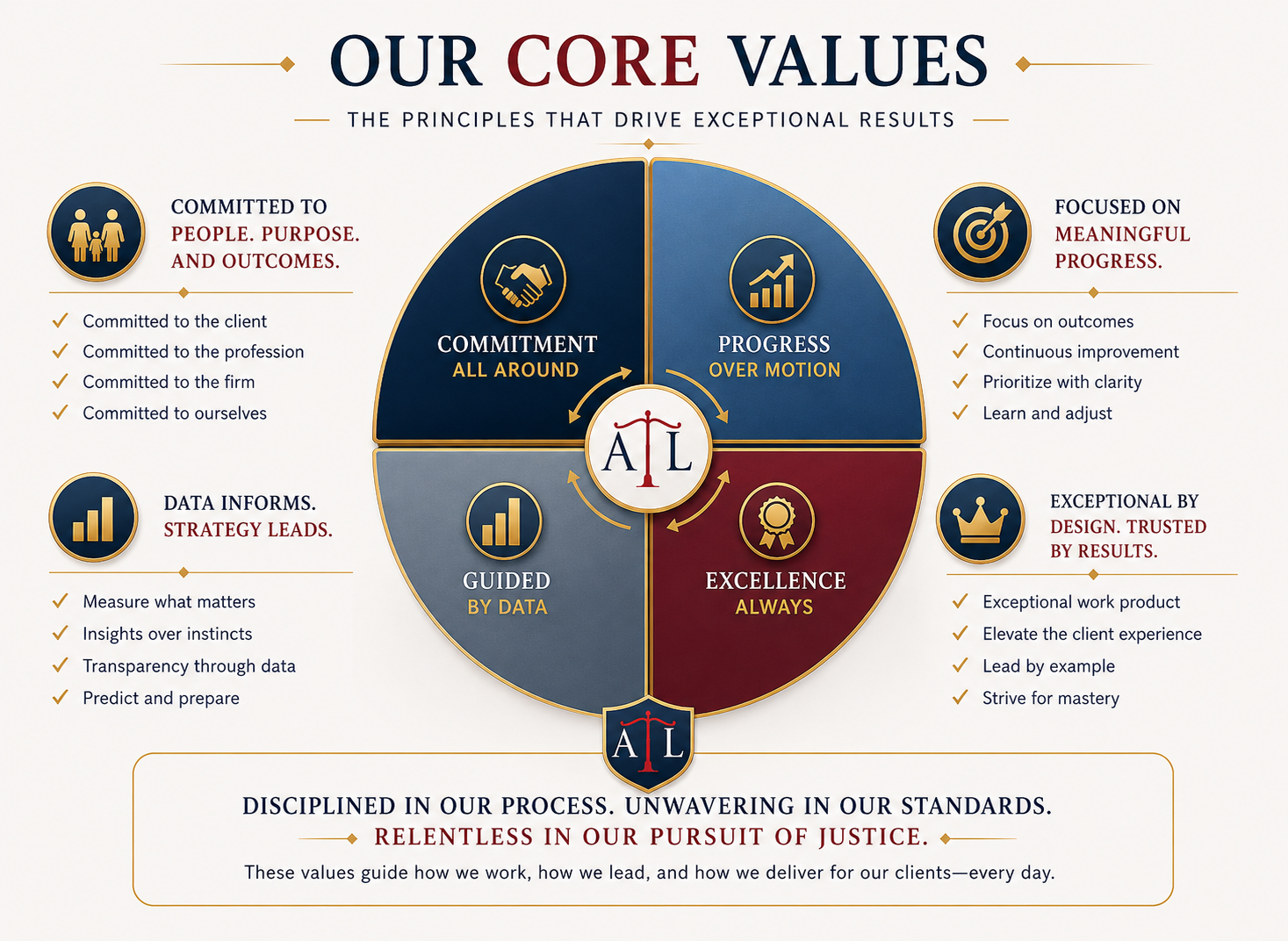
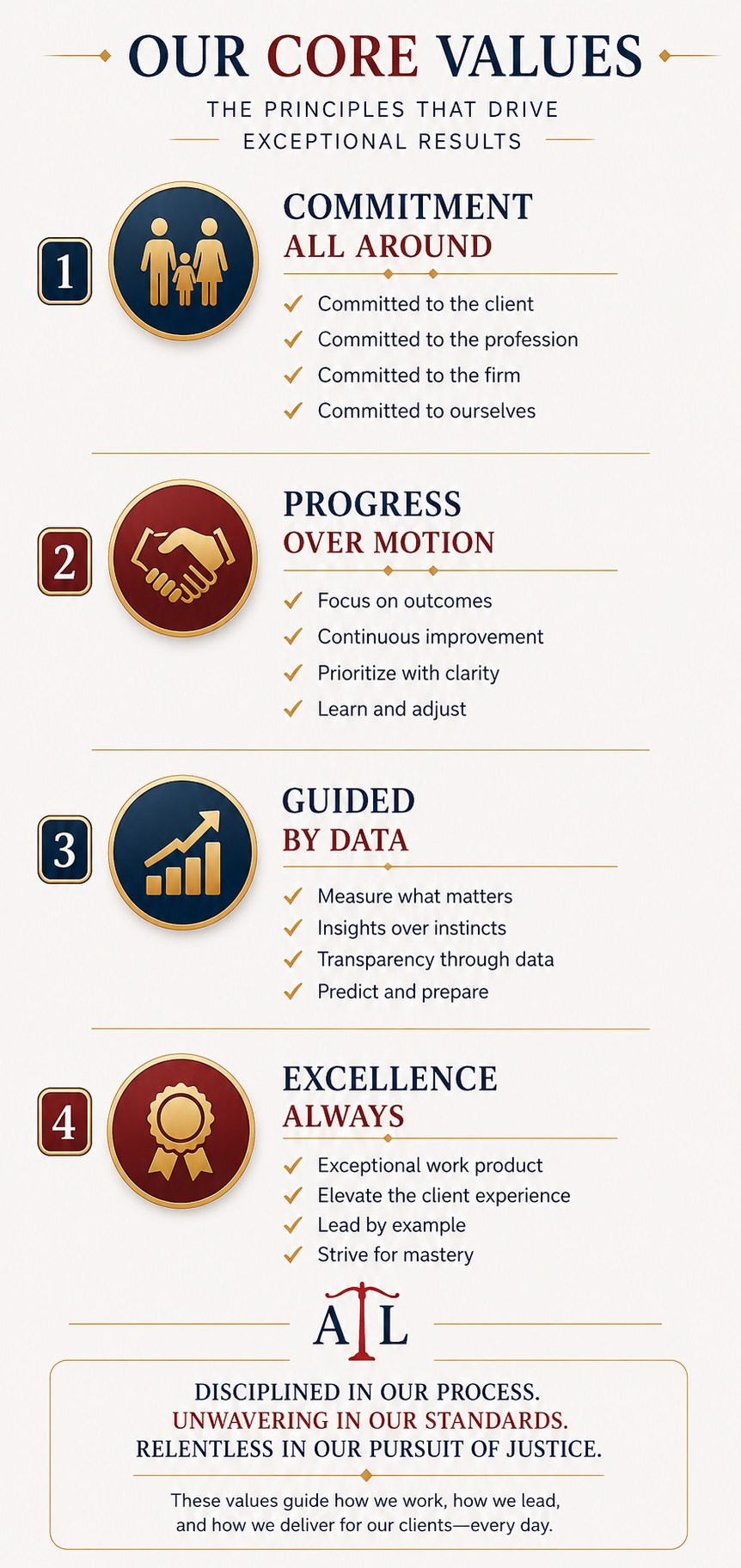
Four values shape how we work.
They are not aspirational language.
They are the operating rules of the firm.
Commitment All Around
Committed to the client. Committed to the profession of law. Committed to the firm. Committed to ourselves and to each other. There is no one in our office whose job it is to do less than the work needs. We all pick up the trash figuratively, when something needs doing that wasn’t anyone’s specific assignment, and literally, when the office needs it
Progress Over Motion
We don’t confuse motion with progress. Activity is not the same as advancement. A pleading filed for the sake of filing is motion. A pleading filed because it moves the case toward resolution on the client’s terms is progress. We measure ourselves on progress, not on hours billed or pleadings generated.
Excellence Always
Excellence in everything including the things that look small. The structure of a brief, the formatting of a contract, the punctuality of a deposition, the clarity of an email update to the client. The seemingly inconsequential details are, more often than not, the ones that decide outcomes.
Guided By Data
We make decisions on facts, not feelings. Litigation, in particular, is full of moments when it feels right to push, settle, fight, or fold, and feeling right has nothing to do with whether it’s the correct move. We build cases and counsel clients with the discipline of evidence-based decision-making.
Our Approach– The Structured Value Framework


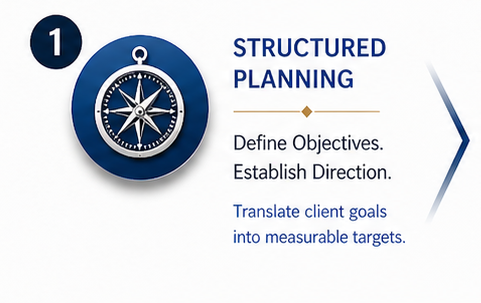
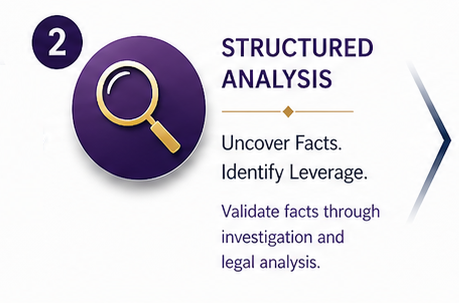

Quality legal work doesn’t happen by accident. We deliver it through a four-stage framework that runs from the day a client engages us through the resolution of their matter.
Stage 1: Structured Planning
Every engagement begins with a comprehensive intake not a script, but a structured conversation designed to capture the client’s facts, position, and objectives. What happened? What does the client want? What does success look like to them?
The output of this stage is an initial plan of action that reflects both what the law allows and what the client is trying to accomplish. It is the document we will revise as the case develops, but never abandon as the starting point of reference.
Stage 2: Structured Analysis
Initial plans are working hypotheses. They get tested against legal research (what the law actually says, what the controlling authorities are, what defenses or claims are realistic) and factual research (what the records show, what witnesses say, what discovery produces). The output is an updated, sharper picture of facts and objectives almost always different from the initial picture in important ways.
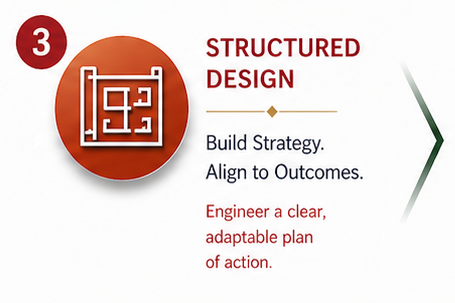
Stage 3: Structured Design
Now we design the right strategy for this client and this case. That requires balancing three variables:
The client’s objectives: including objectives that have evolved as the facts developed.
The cost of legal action: both financial and personal.
The likelihood of success: realistically assessed, not optimistically projected.
These variables interact. A high-cost path with low probability of success is rarely the right answer, even if technically available. A low-cost path that doesn’t actually achieve the client’s objective isn’t a value either. The output of this stage is a strategy customized to the case
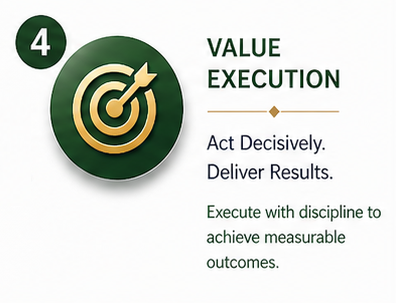
Stage 4: Value Execution
Execution is where the firm earns its fee. We carry out the strategy with disciplined attention to the four inputs that determine whether the engagement delivers what it should:
* The client’s objectives, kept current as circumstances change.
* The cost of legal action, managed transparently.
* The likelihood of success, monitored honestly.
Active client engagement, so the client is part of the decisions, not a spectator.
The outputs are the only three things that ultimately matter: Quality, Results, Value.
Quality | Results | Value
Quality
Quality is our standard for the work itself. It has two components — input and output. The input begins with how thoroughly we capture the client’s perspective and objectives at intake. The output is the work product we deliver: pleadings, contracts, advice, courtroom performance. Both have to be excellent for the engagement to qualify as a quality engagement.
Results
Results are what happens when quality work meets the real world. The result of an engagement is the client’s actual outcome — the verdict, the settlement, the contract executed, the deal closed, the family protected. Results are the output of the quality process. They cannot be guaranteed, but they can be relentlessly pursued.
Value
Value is measured from the client’s perspective. The benefit of our representation should exceed its cost — meaningfully so. When the numbers do not work, and the cost outweighs the likely result, we say so. We have even on occasion advised clients to end engagements that no longer make economic sense for them.
Access to Justice Program
Anunobi Law believes in giving back to the communities we serve. Both the firm and our employees support local charities, and the firm dedicates a portion of its time each year to pro bono representation through our Access to Justice Program.
The need is real. The State Bar of Texas estimates that nearly six million Texans qualify for legal aid, but the Texas legal community currently meets only about 20 percent of that demand. Quality legal help is expensive; we know that better than anyone, but we believe the house of justice should be open to everyone who seeks it, not only to those who can afford to walk through the front door.
Our firm pledges pro bono hours each year to support clients who would otherwise go unrepresented.
Eligibility
Applicants with annual income below $50,000 may apply for consideration. Anunobi Law makes the final determination of which applicants to accept, based on the merits of the matter, the nature of the need, and our capacity at the time of application.
How To Apply
- Complete the application form on this page.
- Email proof of income and financial need to atj@businessandfamilylawyers.com.
Please include details about your case and a brief explanation of why we should consider your matter. Please do not call our office to inquire about the program. We are unable to discuss applications by phone. If your application is successful, we will contact you by email.